Wednesday, October 3, 2012

Bayamón

Well, it has a reputation, does Bayamón, for two things. Officially, it’s the city of the chicharrón—the pork rind fried in lard. Sorry, but even reading about it has added twenty points to your cholesterol. 
And the unofficial reputation?
The city of tapones—that would be traffic jams.
Well, I did neither the chicharrón nor the tapón. In fact, I strolled into the ferry terminal in Old San Juan, sailed to Cataño, and then took a público to Bayamón.
Well, it was old territory. I used to do this trip for years, several times a week. The Home Office for Wal-Mart was in Bayamón, behind store 2501 in a new and awful mall—Plaza del Sol.
My students all knew that.
But I was going to a different Bayamón—Sierra Bayamón. It’s the old part of town, the original part of town.
Students don’t know that!
It’s a testament to how the automobile has changed our lives. Unless you live in Bayamón, all you’ll ever come here for are the malls—Plaza del Sol, Santa Rosa, Río Hondo. This you’ll easily do in your car. But Sierra Bayamón is best done on foot.
So here’s where I started….


Yup, the famous públicos! Walk two blocks, and you’ll get to what every town in Puerto Rico (and most of Latin America and the Iberian Peninsula) has—a plaza (town square), a Catholic Church, and the City Hall. Most of the time, of course, the City Hall and the Catholic Church are facing each other, with the plaza serving as neutral territory between.
It made sense for decades—rather, centuries. Before the movies, before television, before air conditioning, you had to go somewhere to amuse yourself, escape the heat, and meet people. 
That was the plaza.
All that’s changed, now. And, as usual, I’m behind the times. I once waited for hours at the plaza in Yauco, while Harry spent the equivalent time scouring through Yauco Plaza—the mall at the edge of town.
All this is an age before cell phones….
So here’s the plaza, or the plaza del pueblo:


All right, one small corner of it. And what are the guys doing?
Dominoes—very big in Puerto Rico….
In fact, the plaza del pueblo is quite lovely, here in Bayamón. Lots of big trees, and the shade is welcome….
Hey—shade, good friends, a pleasant game of dominos! Life’s good in Bayamón!
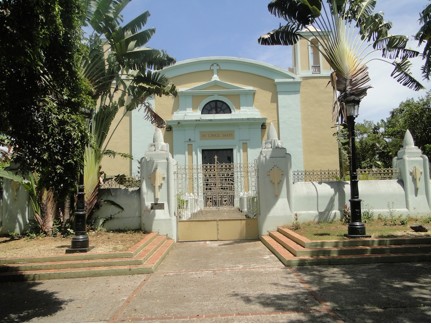
And here’s the church.


OK—it’s an old structure, unfortunately modernized. Sometimes it’s a bad thing, to have some money….
But all is not lost, because across the street…. 


It's the Oller Museum. Originally (I suspect) the City Hall, it’s now a museum devoted to one of Puerto Rico’s best artists, Francisco Oller. The guy’s a serious painter, studied in France and Spain, and was a friend of Pissarro and Cézanne. Have a look!

Francisco Oller, Hacienda Aurora, Oil on panel, 1898-1899 (Museo de Arte de  Ponce, Puerto Rico)
It’s a nostalgic view of, perhaps, a terrible time. One wonders—did Oller paint it on site? Or in France, far from home? One thinks of him, in the cold, dark French winters, huddled perhaps in a cold atelier, warming himself with memories of home.
The reality was different. And though few people know it, Bayamón was the site of one of the few slave revolts in Puerto Rico.
Here’s—who else?—WikiPedia:
According to his plan several slaves were to escape from various plantations in Bayamón, which included the haciendas of Angus McBean, C. Kortnight, Miguel Andino and Fernando Fernández. They were then to proceed to the sugarcane fields of Miguel Figueres, and retrieve cutlasses and swords which were hidden in those fields.[1] Xiorro, together with a slave from the McBean plantation named Mario and another slave named Narciso, would lead the slaves of Bayamón and Toa Baja and capture the city of Bayamón. They would then burn the city and kill those who were not black. After this, they would all unite with slaves from the adjoining towns of Rio Piedras [note 1], Guaynabo and Palo Seco. With this critical mass of slaves, all armed and emboldened from a series of quick victories, they would then invade the capital city of San Juan, where they would declare Xiorro as their king.[1][9]
Well, does sound like a plan! Just one hitch….
Unfortunately for the slave conspirators, Miguel Figueres had a loyal slave named Ambrosio who divulged the plans of the conspiracy to him. The whistleblower also had both personal and financial interest, as slaves who reported any kind of slave conspiracy were granted their freedom and 500 pesos.[3] Figueres then informed the mayor of Bayamón who mobilized 500 soldiers. The ringleaders and followers of the conspiracy were captured immediately. A total of 61 slaves were imprisoned in Bayamón and San Juan.[1]
¿Bíjte?! There’s always one water party (aguafiestas or party pooper, in Puerto Rican Spanish).
Well, well, there’s much to see in Bayamón. Readers of Iguanas will know of the elfin Dr. Veve, who blew in one day only to find English a bit deflating. So I was pleased to find myself here, contemplating the sign….


And the landscape is indeed pleasant. Here’s a typical storefront….

Walking a bit further one comes to this….


It’s Bayamón’s tribute to one of the most amazing things in Puerto Rico—the troubadour (el trovador).
Yup, you heard me right.
Puerto Rico has had and continues to have an extraordinary history of the troubadour.
Suppose I gave you a line, say de lo frío a lo caliente, or “from being cold to being hot.” Now, all you have to do is improvise on the spot a poem sung to music of ten lines, with the first four lines ending in ABBA, the second four lines ending in ACCD, and the last two lines being DC. And the last line has to be the line I gave you, the de lo frío a lo caliente. That’s called the forced foot, or pie forzado.
My bet? I’ve lost you even in the request. And no way could you do it.
Especially since each line has to be eight syllables. And that’s only if the last word of the line doesn’t end in an accent on the final syllable, in which case the line has seven syllables.
Unbelievable, as Gunnar might exclaim.
But there are guys who do it.
Years ago, driving in the country, we came, Raf and I, on the gentle sound of the cuatro and tiple and the tenor voices singing the décimas, as they are called. Raf stopped the car by the side of the tree-lined road, and we walked, holding our breath—could it be possible?
It was. Fifty or a hundred people, all sitting and listening to people of varying ages engaging in this centuries-old tradition. (The first décima came to the island in the 16th century.)
Best of all, it’s a tradition that is getting stronger. Check out this link….
One New Year’s Eve, I was sitting in a restaurant with Raf’s family. And there appeared a troubadour, who improvised a décima with a line or couplet based on each member of the family. And when he came to me?
Well, they explained it later.
With typical, gentle humor, it went something like this:
Welcome, good stranger, from across the seas:
If you love Puerto Rico, stay: if not, leave!
Guess he has his answer!

Tuesday, October 2, 2012

Gorditas and a fallen woman

Always aiming to be of service, I give you this advice, should you find yourself boarding a público: try to sit as close to the door as possible. Also, try NOT to sit next to gorditas.
Why? 
Well, gorditas are young ladies who carry some heft to them. They occupy space. And when the chofer decides to impose the four-person-per-seat rule, he’ll cut no slack. Four people is four people, no matter their size. 
It’s especially bad if you are a flaquito (the gorditas’ opposite) like me, and if the gorditas are on both sides of you. Which in fact they were. So there I sat, looking like a shirt being squeezed out of an old-fashioned wringer. 
Well, the gorditas were students at a school of aesthetics (escuela de estética) which, no, doesn’t mean what you’d think. These little chubbies were not discussing philosophical principles or the properties of beauty and proportion—they were learning to cut hair. That’s aesthetics, down here.
I know this because one of them showed me her “practice head.” Real hair, it seems, is too precious to waste on anything less than experienced aestheticians. Gotta practice first. And she told me what I had always wondered. Yes, the practice head is full of “hair.” After you’re done aestheticizing (oh, of COURSE that’s a word!) you simply snip of the excess aesthetics and start again!
Well, well, something to know….
And happy I was to chat with the chubbies, because, really, the landscape is dreary, in this part of the island. The western edge of the city is a painful repetition of fast food outlets, strip malls, tire shops, car repair shops—all crammed next to each other, and all with monstrous signs with clashing colors. The only break comes when you lift your eyes, and see El Yunque, the tropical rainforest located on the highest mountain in the northeast part of the island.
That’s what I was looking at when the silliness started.
“¡Pare, pare! Hay una señora corriendo, y si ella se cae…” Hey, stop—there’s a lady running for the bus, and if she falls….
“Será una mujer caída….” She’ll be a fallen woman. (this, said by a young lady next to the window.)
Yes, it means just the same in Spanish.
Could it be? Would it finally happen? For my last three trips in públicos had been nothing like what I remembered from years before. Long, extended jokes and gags. Laughter. Gentle teasing and good humor.
Well, the lady catches up to the van, and it’s clear—she’s not colorless. Quite the opposite, for she is chattering the moment she enters and promises not to stop until she exits.
“Ay, mi madre, ¡es la cocina pa’mí!” Oh my lord, it’s the back of the bus (literally, the “kitchen”) for me!
She squeezes her way past, and sits—rather wedges—next to the guy I’d been talking to, those minutes-read-hours at the bus stop.
“Puej, la última vez que estuve en una pisicorre, estaba casi en la falda de otro pasajero…” The last time I was in a público, I was practically sitting in someone’s lap.
“I would be happy to provide that service,” says the guy.
Instantly she is outraged-womanhood.
“¡Señor! ¡Soy una dama casada y respetable!” Sir! I’m a respectable, married lady….
“That hasn’t been established. In fact, it was challenged even before you entered the bus!”
The lady is horrified!
“!¿QUÉ?! ¿Qué usté dice, señor? ¡¿La gente estaba hablando de mí, antes de llegar aquí a la gaugita?! !Qué cosa! ¿Y quién estaba hablando de mí??”
The guy points with his lips (a Puerto Rican thing) to the young woman.
“¡¿QUÉ?! ¡Una mujer como yo, hablando sapos y serpientes de mí! ¡Nena! ¡Qué vergüenza!” What! A fellow woman talking snakes and toads about me! Girl! No shame!
Well, now it’s a trio, as brilliantly witty as anything Haydn wrote. The lady is all outraged innocence, caught against her will between a lascivious man and a saucy young lady. And everything they say plunges her more deeply into her perilous hole. At last, she can bear it no longer!
“Usted, señor,” she says, tapping my shoulder, “make room for a poor thing seeking protection.”
She notes that I am gringo.
“Puede ser que él no entienda….” Maybe he won’t understand….
“Claro, señora. Señorita, move just a bit, to offer protection to the fallen woman….”
This is met with a horrified squeal.
“Ay, ¡mi madre! ¡Los hombres! ¡Son todos iguales!” All men are alike!
“Don’t move a muscle,” says the guy behind me, “it’s been months since I’ve been this close to a beautiful lady….”
“Ay Dioj mío! ¡Un hombre desesperado!” Oh my God! A desperate man!
Well, it goes on and on, as we pass the dreary stores and encounter a street flooded for an entire block. And it never goes over the edge, never gets vulgar, never is less than light-hearted and fun. But at last, the saucy minx gets out, the man as well, and finally, our lady of the wounded virtue.
“Santos,” she says, backing out of the van, “thanks heavens my saintly mother wasn’t here to see this spectacle!”

Monday, October 1, 2012

Confusion in Condado

It was Joan Didion who said that hotels are social constructs, and I read the sentence in my teens and nodded sagely and wondered…what did it mean?
Well, I’m still not sure. I could call up Pablo, a social anthropologist, and he could tell me—but would I understand? His last explanation, about the meaning of the Passion and Lent, left me completely confused. Then again, they weren’t my best days.
Anyway, Pablo’s busy, so here’s my guess. Hotels present a vision of themselves and of their guests that people buy into—or not—depending on the degree of the match. You feel safe in one hotel because it’s clean and people call you Sir and the ashtrays have perfectly raked white sand and the marble floors are spotless and it’s real silver, not stainless steel.
Oh, and you’re paying 350$ a night so it better be clean and click your heels when you call me Sir!
And you know, of course, that the guest next to you is paying roughly the same. So, of course, you’ll watch his kids while he gets a drink from the bar. He’s one of us (or whom we’re pretending to be….)
Which is all to say that I went to Condado—one of the two tourist areas of San Juan. And confession—no, not by público. There are no públicos in such places, though there are buses that go there. But we chose, Raf and I, to take a cab, since traffic into and out of the small isleta of San Juan was murderous.
First cab driver—very obviously from Santa Domingo. Not lacking in testosterone, or unwilling to engage in zestful and creative driving practices. And completely disdainful of the police, who were actually causing the traffic jam, and the bicyclists racing on the avenue below, who were the ostensible cause. 
Many of our taxi drivers, by the way, are Dominican, and many are probably undocumented. Certainly, most of our construction workers are Dominican. And they arrive here after having saved enormous sums (thousands of dollars at least) to purchase a seat on a leaky wooden boat to travel the Mona Passage from Dominican Republic to Puerto Rico.
Two facts about the Mona Passage:
It’s the deepest part of the Atlantic Ocean
It’s filled with sharks
Right. A guy once told me of the experience, which has to take place in the dead of night, and which depends on an ancient outboard motor, and the skill of the guy working it.
Am I imagining it, or did he tell me—a guy you’re not allowed to see? Turn your head and you’ll be shot.
If you’re lucky, you’ll get to a little beach in some rural area and face your next problem. What to do now?
Well, this I do remember. The guy knew that his sister lived in Santurce—a barrio in the metro San Juan area. And then the word spread through the group on the beach. There was a público waiting to take them. Yup, at 5 in the morning, a público that would take them to safety at the price of…
…100 dollars each.
What are you gonna do?
So the cab driver probably had a similar story. Or not. But the chances are better than even that he did.
Well, well—the traffic continued terrible. We got out of the cab a block away from the hotel, giving the driver a break: the last block was the worst of all.
And then strolled into the Marriot Hotel—yup, the same Marriot whose sacred undergarments had saved him from a terrible burn.
OK, in a post about classism, I’ll come clean with my own.
This is a hotel for people who have money, and perhaps shouldn’t. Lots of mirrors, marble everywhere, chrome. Loud Latin music. Rattan furniture. What won’t you find?  A quiet, unrefrigerated corner. Mahogany or gleaming, polished brass.
We were there to meet an old classmate—whom I’ll call Isabel—of Raf’s, a lady who had just finished a cruise, and was staying a day or two extra at the hotel. She was with her husband, a Texan who speaks no Spanish, and who was in the military for many years. He greeted us with his bourbon in hand, and we sat to chat.
There is, in fact, a lot to commend this guy. He treats Isabel very well, unlike her first husband, a Puerto Rican who had all of the worst habits—skirt-chasing being number one—of Puerto Rican men. But Isabel learned—Jim, her gringo husband, treats her like a queen, comes home and stays home at 5, and hands the paycheck over every two weeks. Oh, and Isabel works as well, and reasonably decreed that she wouldn’t cook or iron. So Jim does that. Or they go out to eat, and Jim pays.
Well, Jim’s drink was done, and he “danced” his way to the bar. Those quotes because, look, it was only a crude imitation of some Latin dance step. But no problem, because the barmaid imitated him exactly, and put on her best smile. They held both hands, smiling and swaying, as he placed his order.
Looking at her, I could see the tension in her jaw, she was smiling so hard.
Well, several bourbons later, Jim went to another bar. He courteously asked all around if anyone wanted anything. His wife wanted a Riesling. 
Well, it’s not a common drink on the island. And the kid at the bar didn’t have any.
Jim disputed that—there was Riesling in the house. His pal at the first bar had come up with some twenty minutes ago. What gives? Go find some.
“It’s the last time we’re staying in this hotel,” said Jim, when he returned in disgust.
And so we went on to talk about the younger generation, and their complete lack of a service mentality. Meaning perhaps that they don’t dance over and hold hands when Jim approaches?
But it gets more complicated.
“I felt ashamed of the Puerto Ricans we saw on the cruise,” says Isabel. “They were loud and vulgar, and you know what? They were justifying the worst stereotype of Puerto Ricans. And you know, there IS an educated, professional class in Puerto Rico. I’m part of it.”
In this, she is completely correct.
“Vergüenza ajena,” I say. Shame for my brethren.
Right, so I’m hungry, and I go to see if we can get some sorullos—fried corn sticks, and mighty tasty. I approach a woman and ask her, in Spanish, if there might be some. 
She replies in English.
OK look. My Spanish is neither great nor bad. It is absolutely adequate for this task. Her reply indicated that she had understood me fully. But she resolutely spoke English to me, just as I spoke Spanish to her.
Hunh?
Was it that I was trying to cross a border that I shouldn’t cross? You are a guest, and a gringo. No Spanish for you!
OK, we’re now joined by another classmate, also now living in Texas, and also, it develops, a gun collector.
Like Jim. 
“Are you packing,” I ask.
“No way, I don’t have the permits that Jim has,” returns the other guy, named (falsely) Oscar.
But Oscar shares more than a love of guns with Jim. They have ideology in common.
“I really think we’re gonna have to figure out where we’re living if Obama wins,” says Oscar, “I’m planning on Costa Rica.”
“I’m thinking Norway,” says Jim.
Who tells the story of talking to an old woman from Ohio, and how brainwashed she was by the Democrats demagoguery about oversea investments and tax breaks.
“She was a lost cause,” he said.
“You know, I really fear for this country if that guy wins…” he added.
I wanted to walk away. At the same time, I felt sad. My parents, ardent Republicans, walked to the polls with their friends, ardent Democrats. Why were they doing it, they asked. Our votes are gonna cancel each others’ out. Then they realized. They were checking up on each other. If they stayed home, well, the other couple might sneak out and vote!
They laughed.
No one was laughing last night. And I, in particular, wanted to get away from gun-lovers and Republicans. It was getting late as well. So I took another cab home.
OK, act 3. I bid farewell to my hosts and go to get a cab. I know how to do this now, though it took me a while to learn. I address the guy wearing the silly white imitation-sahib-from-India as “caballero” and he produces a driver. We walk to his car.
“I speak perfect English,” said the taxista.
“I come close,” I said, “pero tengo que practicar mi español.” I gotta practice my Spanish.
So we spoke Spanish, and I asked him about business. 
Not so easy. His van is rented, and costs him 1200 bucks a month. Gasoline is over 4 dollars, and he can’t afford to fill his tank, which would help his mileage. Bottom line—he has to clear 80 bucks a day just to cover his costs.
Right—so how many trips is that?
About four or five. And there are always five or ten cabs waiting at the hotel.
So how many hours a day?
10 hours, seven days a week.
Wait—what about buying, not leasing.
Well, Christian—I’ve learned his name—knows the numbers. He’s got an MBA.
What!  And you’re driving a cab! Look, with your degree and your English, go to Orlando, go to the States.
And leave his three-year old son on the island with his divorced wife?
OK—so what about somebody in your family who can help you get the 9,000$ for the down-payment of the 45,000$ that you need to buy, not lease, your taxi?
Whole family is poor. Welfare, subsidized housing, food stamps.
That 47% that leeches off the government.
Except that Christian is also part of that 47%. And he’s out there 10 / 7 / 365. That’s ten hours every day of the year.
I’ve checked none of this, of course. For all I know, Christian never completed high school, has a criminal record as tall as the Empire State Building, and daily shoots 200 bucks of white powder up his nose. Didn’t see any of that, though.
What did I see? A guy on his umpteenth bourbon. A barmaid doing a perfect imitation of a bad imitation of a dance step. A lady who addressed me in excellent English in return for my average Spanish and called me Sir. A cabdriver who broke the numbers down as well as the financial guys at Wal-Mart ever did.
Did I go to Condado, or Confusion?

Sunday, September 30, 2012

More waiting….

Well, it troubled my day and vexed my night, that question of mine. So I asked Mr. Fernández at the dinner table.
“Where are the readers? I wrote a post today and left myself stranded on the side of the road, waiting for a público that might never come. And then I sat down with my cell phone in hand, expecting the calls of concern to come flooding in. And guess what! Not one! Nobody, but nobody, called.”
Mr. Fernández was patient, he frequently is. He explained that readers—more intelligent than I—would assume that if I were posting blogs (or blogging posts, don’t know which), I must have found my way to safety, or at least Wi-Fi.
Oh.
Well, the Remeron may not fully have kicked in. Or maybe it was just remembered dread. Let me explain. Getting off the island of Culebra was a breeze. For 2.75$ I got a ferry ticket, and sat in wonderful comfort and watched the ocean drift by. Culebra does that to you—puts you in such an alpha state that whitecaps become compellingly interesting.
Landing in Fajardo smashed all that!
Here’s the deal. The públicos are supposed to be just that—public. They’re not taxis, which are private. However, there are no taxis—just públicos. So guess what! There were all these públicos and about six of us who were not parked 500 hundred feet away. Right—six of us, five of whom saw the logic of paying ten dollars for a now-non-public público for a private ride to wherever they were going.
Guess who didn’t see that logic! And who, in the blazing heat of Fajardo Playa, forgot the words he had written: “arguing with a chofer is like arguing with a cat.”
Well, I was rescued, as I always am, by an old man who took pity on a ridiculous man and told me he would take me wherever…
…free!
The universe provides—though on its own timeframe.  
So I was sitting in comfort and listening to two other gringos practicing their Spanish and then I turned and saw it—a público marked Farjado to Río Piedras! Just what I wanted, I told my driver / friend / rescuer. 
No, that was Indio, and he’s going home for the day.
But then he saw another público. And that was the one for me.
But it was just going to Río Grande.
And that, Intelligent Readers, is how I came to be stuck in Big River.
Waiting on Highway 3—well, beside Highway 3—for a público that might never come.
Fortunately, I had company. The guy had lived in New Jersey for nine years and loved it. It was clean! It was orderly! You had a broken light on your car? Well, get ready, ‘cause the first cop you meet is gonna pull you over, take your license, and you’ll be at the station, next day, with your car repaired and your license back in your wallet! But here! Look at that car!
OK, it was more duct tape than car, but the guy driving it?
Wow!
And what about the status issue! Do you think this referendum is going to settle that? What do you think!
Puerto Rican readers will know, and will have tensed. Others won’t. Here it is: a group of Puerto Ricans favor statehood, a group favors independence, a group favors something called the Free Associated State, our current status.
This had puzzled me, those twenty years ago when I came unSpanished (I see you, you little red squiggly line, but I like it, it stays!) to the island. But even I could figure out Estado Libre Asociado.
But what did it mean?
“IT’S A LIE, A VICIOUS LIE!” screamed Mr. Fernández over the dinner table. I became alarmed—I had never seen him violent before. I removed trajectables (sorry, computer!) from reach.
Then I figured it out. The status issue had to be somewhere close-by.
“You’re a cultural genocidalist,” said Harry’s father to me, years ago. “It’s nothing personal. But your country has practiced genocide on my country. You therefore are responsible. And though I have nothing against you, I have to tell you that you are personally and individually responsible for the great wrong that has been done to my country.”
He was quite calm, but it seemed best to agree.
And he taught me a great lesson, which I—added value, as we used to say in Wal-Mart—will now teach you.
You are paying attention, right?
Never talk status.
The trick is to inquire what your interlocutor thinks, and then nod your head, appear thoughtful, and agree.
Were I in a classroom, I would have you practicing—it’s conversation / conversación 101.
Right, wow, good point / claro, estoy de acuerdo; muy buen punto.
“The whole thing is ridiculous,” my buddy of the bus stop was saying. Look around you—Walgreens, Sears, Wal-Mart! Statehood is already here!”
And then, we spotted the público. Instantly, we dropped the question and stood jumping by the road and flailing our arms—they were still sore the next day.
But relax, gentle reader. It slowed, we opened the door, we plunged our bodies through to our seats.
You can sleep easily tonight—I was rescued.

Saturday, September 29, 2012

Waiting in Big River

Well, it was the moment I had been expecting, or maybe fearing. I was on the side of the road just outside Río Grande, waiting for a público.
I had decided to do it. Get out of the house. Get onto the island. See something else, talk to other people, look outward, not inward.
It is a solitary business, after all, this writing thing. In New York, there are places where writers, poets, artists get together to work alone but with other people nearby. And they hang in the kitchen, drinking coffee, talking about their projects.
And I see why. So here was the challenge—how many of the island’s municipalities could I see by public transportation? And what would I see, what would I find there? And why do it?
Well, maybe just because. And maybe because there’s a whole subset of Puerto Rican culture out there that no one listens to. Or writes about. Or maybe it was just for that best of all reasons…
…just for the hell of it!
Well, Sonia thought it was a good idea, when I explained the project.
“I think Puerto Ricans may be very stratified,” I said, fearing she would sniff criticism.
“Yeah? BOOKS have been written on the topic!” she cried.
And then went on to tell me her público story. 
It was early in the morning, she was on the way to work. Behind her, a middle-aged man was whispering his sad story to another.
“Papi died last week.”
“Ay,¡que lástima!” Wow, that’s a shame.
“Sí, but that’s not the worst of it.”
“Whaddya mean?”
“It was me. I was responsible. Listen, I killed my own father!”
“Listen, that’s crazy. I’m sure you’re just feeling guilty. Everybody feels that, after someone they love dies. Don’t worry, I know you were a good son.”
“No listen, you don’t get it. I’m not feeling guilty, I killed my own father, really killed him!”
Sonia, you remember, can’t see these guys, and also, well, can’t help but hone in on this radio show.
Be honest—could you?
“Look, whatever you did, I’m sure it was with a loving heart.”
“That was the problem. I couldn’t say no. He begged and begged me, even though the doctor told him—one drop of alcohol and you’ll die. But he’d been guzzling the Palo Viejo for years. He was going crazy. He pleaded and pleaded with me.”
Sonia is imagining the scene—the old man sitting on an ancient sofa; the sacred heart of Jesus, immediately above his head; the ceiling fan barely stirring the dust of the hot, humid room. The son, anguishing.
“So?”
“So I went to the colmadito and got him a caneca.”
A flask of Palo Viejo rum….
“No,” breathed the other man.
Sonia sees the old man’s gnarled hands, twisting off the cap in desperation, rushing the flask to the parched lips, spilling the rum on his guayabera on the way.
“So what happened?”
“It was terrible! Papi took the flask, drank the whole thing in one gulp, and…”
“Yeah?”
“Fell down dead on the floor!”     
You can imagine the silence in the público…..
But it gets better!
“Wow—that’s terrible, just terrible. And how many years did Papi have?”
Ready?
“One hundred and three.”
Sonia is holding her breath, trying not to burst out in guffaws….
The other guy?
Goes on just the same as ever!
“Wow, qué trágico! That’s a shame. What a pity.”
So yeah, it’s a tradeoff. You cede all autonomy, comfort, personal space when you cast yourself to the fate of the público—which may in fact never even come.
Flip side?
Stories like that….