Wednesday, July 23, 2014

Cynara, Come Home!

“She can never do this again,” said Montalvo, “and our big mistake? We should have gotten that padlock at the hardware store, and locked the gate of her apartment house. Nobody goes in or out—especially out—with suitcases!”
“I totally agree,” I said, “Imagine, just upping herself off to France, on the flimsy excuse that her husband is whole-French and her daughter is half-French. Remember how they told you, in grade school, that they hoped you’d brought enough for the whole class—when they caught you eating candy? Well, it’s the same thing: she can’t go anywhere—especially for a month—unless she takes everybody with her…”
It’s been a long month without Lady, the owner of the café, who generally mothers or sisters us as needed. Oh, and in the case of Mary Anne, her 70-something-year old neighbor, Lady even daughters her. So all of the creative verbdom, which she does so well, has left us bereft, in her absence. And we’ve been chafing without her, and now that she’s set to return, will we be reft again?  
“It was an unexcused absence, and that can’t be allowed to pass without consequences,” I tell Montalvo. “She should never be allowed to do this again.”
“And you know,” I continued, “if she were really going to be all French about it, she’d close all the businesses and we’d ALL be on vacation.” So we total it all up, and discover that it’s easily twelve people who would be trailing along with her—rather, being her distinguished guests—in France.
“It might slightly defeat the purpose of a vacation,” I told Montalvo, “to be bumping into all the people you’ve been bumping around with for the last two years, which is why I think it’s imperative—she has to rent a chateau.”
“Marc?”
OK—time for a bit of architectural enrichment. Google comes through with this:
“You gonna put fifteen people in that?” I ask him. “Remember when I told you, ‘less is more’ and you didn’t believe me? Well, in this case you were definitely right….”
So now we’re on the track of the perfect French chateau, which of course reminds me of Dorothy Parker’s perfect red rose; we take a little detour through poetry:
A single flow'r he sent me, since we met.

All tenderly his messenger he chose;

Deep-hearted, pure, with scented dew still wet -

One perfect rose.


I knew the language of the floweret;

'My fragile leaves,' it said, 'his heart enclose.'

Love long has taken for his amulet

One perfect rose.


Why is it no one ever sent me yet

One perfect limousine, do you suppose?

Ah no, it's always just my luck to get

One perfect rose.
“More iambic fucking pentameter,” remarked Montalvo, “except for the last line in all the stanzas…”
“You are not as you were under the reign of the good Cynara,” I tell him, needing to elevate things a bit from Dorothy Parker. So I derail that line by telling him that Parker had such fulminant writer’s block that her husband took to putting a human hair on the keyboard of her typewriter. As I remember it, it could be there, undisturbed, for months, though Parker swore that the nightly martinis were just recompense for a day slapping away at the keyboard….
Right, time to return to our French lodgings….
Montalvo proposes this:
“Still rather modest,” I told him. “The point, after all, is that you want volitional, not involitional, bumping into people. Try this….”
“Motherfuck,” he says, “they let Niggahs in there?”
“Lady will tell them,” I say. “Hey, and imagine drinking sherry before dinner here….”
“The staff will have to be sent away on paid vacations,“ I said, “since Mr. Fernández will insist on an English staff. And of course, you’ll have to know the service names of all the staff….”
“Hunh?”
“What do we call the chauffeur?”
“His name?”
“Wrong—the chauffeur is always ‘James.’”
“Hey, you can’t do that!”
“Oh, they love it,” I tell him. “And the upstairs maid?”
“No clue….”
“Daisy,” I tell him, “and the downstairs maid?”
“No idea,” he says.
“Exactly—no one cares about the downstairs maid, so she has no name!”
“But that’s terrible,” cries Montalvo. “You can’t be changing around the names of people!”
Reality sets in—how many cups of coffee will we have to sell to get a chateau for a month? We set aside the idea for a moment, and consider other plans….
“Maybe we should move everything around,” said Montalvo. “We’ll put the coffee shop in the gift shop, and vice versa. Then, when she comes back, we’ll act like nothing happened, and look at her funny, and say, ‘well of course it’s always been here. I mean, if you hadn’t been away so long….’”
“Too much work,” I told him. “And besides, she’s coming back today. Hey, what if we closed all the stores, put the hurricane shutter up, and posted big notices—OUT OF BUSINESS, LIQUIDATION!”
“EVERYTHING MUST GO!”
“On the gift shop, we put “REPOSSESSED!”
“Right, and on the café, we put ‘CLOSED BY ORDER OF THE DEPARTMENT OF HEALTH!’”
“And of course,” I mused, “We could write one of those notices to our devoted customers, thanking them for their patronage—that is, all the moolah they dropped over the years—and saying that we’ll never forget them….”
“Better yet, we go out and get one of those big black ribbons—very much in the Spanish style—and put it on the door, with the sign below it: Marc Newhouse, 1956-2014. Hah! She’ll be sorry then!”
“Don’t tempt providence,” I tell him. And that’s when I tell him…
…“We are not as we were under the reign of the good Cynara!”  
 
   Non Sum Qualis Eram Bonae sub Regno Cynarae
LAST night, ah, yesternight, betwixt her lips and mine

There fell thy shadow, Cynara! thy breath was shed

Upon my soul between the kisses and the wine;

And I was desolate and sick of an old passion,

Yea, I was desolate and bowed my head: 

I have been faithful to thee, Cynara! in my fashion. 


All night upon mine heart I felt her warm heart beat,

Night-long within mine arms in love and sleep she lay;

Surely the kisses of her bought red mouth were sweet; 

But I was desolate and sick of an old passion, 

When I awoke and found the dawn was gray: 

I have been faithful to you, Cynara! in my fashion. 


I have forgot much, Cynara! gone with the wind, 

Flung roses, roses riotously with the throng,

Dancing, to put thy pale, lost lilies out of mind; 

But I was desolate and sick of an old passion,

Yea, all the time, because the dance was long; 

I have been faithful to thee, Cynara! in my fashion.


I cried for madder music and for stronger wine, 

But when the feast is finished and the lamps expire, 

Then falls thy shadow, Cynara! the night is thine;

And I am desolate and sick of an old passion, 

Yea, hungry for the lips of my desire:

I have been faithful to thee, Cynara! in my fashion.


Ernest Dowson

Monday, July 21, 2014

Montalvo and the Big S

It’s easy to forget, because we do it all the time and it’s normal for us, so it was nice of Joshua to drop around and remind me.
He was one of many people who—obviously—I was supposed to remember, and that was clear when he sat down and peered nervously at me; in situations like this, what choice do you have?
“I’m sorry, but I don’t remember you,” I finally said. And he went on to tell me that I had intruded myself on a group of his fellow high-school students who were being coached on their poems for the Poetry Out Loud contest last year.
Here’s my version: I had held back as much as I could, since some of the kids were struggling even to understand their poems, some were consistently mispronouncing words, most were speaking either too quickly or too softly or…something. And the coach? She was murmuring—sorry, make that cooing—the gentlest words of encouragement on them.
And that’s nice, because discouragement? Who needs it? Isn’t being a Latino kid reciting English poetry enough of a challenge?
But there was this thing: if one of these kids was going to go to Washington, DC, to face native speakers from the fifty states, shouldn’t they have a decent shot of it? So there I was, writing and wincing in the corner, and then my father, Jack, dead these two decades, cleared his throat up there in heaven and fixed his gaze down though the clouds at me. His eye is as the eagle….
So I had gently taken over the group, after assuring the coach that she was doing an excellent job, and that I had little, nothing really, to say.
Now for Montalvo’s version:
“Man, you fuckin’ blew those kids outta the water. They didn’t know what the fuh had hit ‘em. Most of those kids didn’t even know what they were saying! You blasted them off the planet, man.”
Well, Montalvo is a youth who measures poetic success with the grade of “PANTIES OFF, LADIES” at the top, so my own performance?
“Jockstraps off, team!”
This, however, was after Montalvo had settled down a bit, because I had made my umpteenth parental blunder by answering truthfully to his question: “did you like my poem?”
When am I gonna learn?
“No,” I told him, and look, you don’t have to be adolescent to hear that as less a word than a slamming door.
The problem? The stuff that seems so obvious to everybody else around me, as they read their poems to each other, I just don’t get. So Montalvo read the poem to me, and then asked: what was it about? My answer, of course, was completely wrong.
“How can you not understand my poetry,” he demanded, “it’s perfectly clear,” and then proceeded to recite the poem again. It’s sort of the equivalent of all the tourists encountering non-English speaking people. What do they do? Raise their voices!
The problem—as I, and only I, see it—is that a lot of the poets are sort of commentators on their emotional fields, as it were. Think talking heads given a news analysis from the wars of feeling. Want an example? Well, I’ve just moved up and looked at one poem, and came upon this:
Our unspoken reason has led me
To understand the world we live in.
OK—looks like poetry, but is it?
So I’ve been telling Montalvo, don’t, please, report in. Instead, break out your verbal paint box, set your brush to work and set my eye and soul ablaze with the colors of metaphors, similes, images, adjectives, verbs that stab the eye. And I had suggested that he might do one short poem, but using an extended metaphor. And since of course—of course!—I hadn’t explained what I wanted, much less shown him an example of one, he had failed. Oh, and then I had panned the result.
There is sadism in teaching. Or rather, there is a time for plain words and honesty. There’s also a lot of bad teachers blaming their students for the bad teaching. So it was time to apologize, and then ask—since the Calvary had come over the hill—if he had read Sonnet 18, by the big S.
“Look, would you just assume that I haven’t read all this stuff,” he snapped, “because it makes me feel like a fuckin’ retard to have to say that I haven’t.”
Right. And so upset is he that he wants me to read it, not him. Is he afraid of encountering a word he doesn’t know?
So I start in:
Shall I compare thee to a summer's day?

Thou art more lovely and more temperate:
Rough winds do shake the darling buds of May,

And summer's lease hath all too short a date:

Sometime too hot the eye of heaven shines,

And often is his gold complexion dimmed,

And every fair from fair sometime declines,

By chance, or nature's changing course untrimmed:

But thy eternal summer shall not fade,

Nor lose possession of that fair thou ow'st,

Nor shall death brag thou wander'st in his shade,

When in eternal lines to time thou grow'st,
   
   So long as men can breathe, or eyes can see,
   
   So long lives this, and this gives life to thee.

So we tackle it, and, the first question?
“Since when can you drop all the ‘e’s’’
“Since forever, I tell him, “though, in fact, nobody in the last hundred years or so has done it.”
“Can I?”
Time to throw a bone!
Well, if he’s going to write a sonnet, why shouldn’t he drop some ‘e’s just to give it a nice archaic effect? That done, we go line by line, until we arrive at the moment I just love:
“Motherfucker,” he breathes.
That, along with “what a Niggah!” is Montalvo’s Presidential Freedom Medal / Purple Heart / Nobel Prize (you choose) tag line. And what poet is not going to be attracted to the idea of, ‘my words, baby, are gonna blast you into eternity? Panties off!’?
So then it’s time to look and see: what has Shakespeare done? How did he use the metaphor through all fourteen lines of the sonnet? How did he extend it, morph it, tweak it? And isn’t it interesting that the poem works, paradoxically, by at once diminishing the summer day, which can be too hot, the winds too rough, the sun clouded, and anyway, it’s all too fleeting? Yet somehow Shakespeare still suggests all this and makes you feel both the wonder of the summer’s day, and that the object is even more wonderful.
A Niggah indeed.
Well, he’s just called now, since it’s raining torrentially and he’s not coming today; he’s on a motorcycle now, and doesn’t want to get the computer wet. This, I tell him, is a good plan, so we agree, he’ll stay at home, where he doesn’t want to be, instead of at the café, where he does. I go back to writing this, and then remember Joshua—the high school kid who remembered me though I didn’t remember him.
“You really helped us a lot,” he said, and went on to tell me that he’s in the university now, studying computer science, but he wants to get back involved with Poetry Out Loud, because that had been the coolest moment of his high school years. Then he looked at me, and I remembered that feeling that day: the kids had looked at me with all the trust and admiration with which my cats had looked at me, in those terrible moments when they had been asking me to help them to their death. When those moments happen, or when Montalvo breathes in that he’s understood a sonnet by Shakespeare?
That’s when I remember…

…teachers make a difference.  

Thursday, July 17, 2014

And Now, for a Change of Bigotry….

You know, it’s a day when I miss being marginalized, not being part of the group, being shunned and despised. Remember those good old days? You could do fun things like wear your grungiest clothes, stay up all night smoking and drinking, get arrested the next morning in whatever protest was on for that day, and then straggle off to plot whatever wits were left in you against whatever exam they had decided to give you. Were you going to join the racist, sexist, heterosexist, materialist, patriarchal, capitalist system?
Fuck that!
Which meant that virtually every institution was your enemy, and would you win the battle? Probably not, but you’d fight it as much as possible. In the meantime, ‘hey, you know where I can score some dope?’
Paradoxically, for gay people, we have won…and lost. Because now, guess what we get to do? Well, this is a copy and paste, so you can be sure I got it all correct….
… join the racist, sexist, heterosexist, materialist, patriarchal, capitalist system.
So that means instead of heading for the baths—which we periodically had to do to proclaim that having the most anonymous sex we could in 8 hours was a political act of rebellion against the (second copy and paste, here—so you can do an eye skip…) racist, sexist, heterosexist, materialist, patriarchal, capitalist system—now we’re putting on ties and going off to work after being up all night with the sick baby. Um—somebody out there tell me who really won.
Well, I haven’t had to put on the tie this morning, but I really dreaded getting to the computer, since my task today? Fearlessly, unflinchingly, this blog has raged against the most powerful of enemies, enemies who no doubt even now, quiver and quail at the memory of my incendiary words. So the work of today? It couldn’t be denied—I had to step in and do something about the 50,000+ children, victims of gang violence and poverty, kids who have walked from their hometown in Honduras or El Salvador, who have walked all the way through Mexico. Enough kids to get the world watching. And what is the world seeing?
I don’t watch television, so I couldn’t tell you, until I came upon the clip below of Jon Stewart, and saw, through it, what everybody else is seeing: good old American bigotry, this time directed at kids. Kids who have walked through the fifth largest country in the Americas to get to the land of the brave and free.
Why? Because at home, gangs have developed to supply our taste for drugs, which previously had moved through the Caribbean—which accounted for Puerto Rico’s murder rate of 26.5 murders per 100,000 people, several times the U.S rate. But the Feds got busy in the region. So now the drugs are moving up through Central America, and kids are being pressed to join gangs and deliver our drugs.
And so we have a problem on our hands, because where do you put 50,000 kids? And you know the answer from the right: these aren’t kids, this is an invasion. There, for the world to see, is a woman chanting, “not my problem.” So these kids should be gathered up and sent back over the border?
Yeah? Back to the communities they left because the gang had killed their brother or parents? We’re gonna send these kids back?
It’s amazing that hatred and ignorance can trump what should be the most basic instinct of all: caring for our young. But that word—“our?” It’s “our” to you and me, but “their” to a lot of other people.
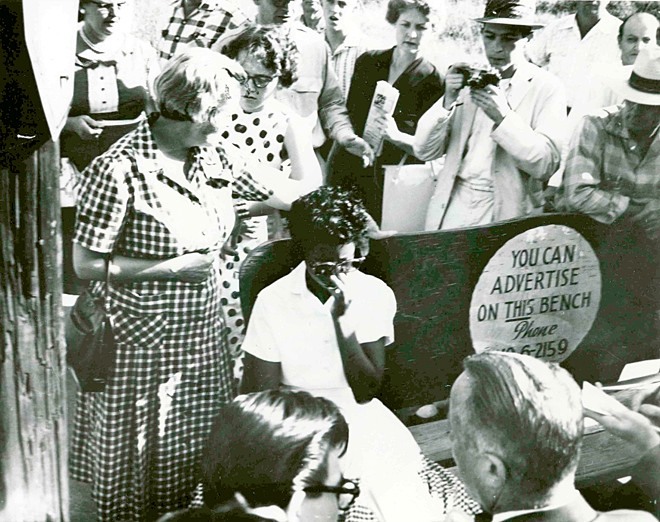
Why am I thinking of Little Rock, Arkansas, in September of 1957?
I knew about the Little Rock Nine, but I didn’t know how bad it was. Because the Supreme Court had ruled on school segregation in 1954, and the message was pretty clear. Still, Little Rock waited until September of ’57, and then decided to admit the nine brightest black kids they could find to Little Rock Central High School.
Nine kids. No problem, right?
Yes, a problem in Little Rock, Arkansas, in 1957. So the governor, who was a moderate, decided to do what anyone would do. Call out the National Guard to…
…prevent the black kids from entering.
Right, if you going to do something like this, you’re going to do it in a group, so no wonder that the nine black kids, with their parents and ministers, presented themselves en masse, or as much of a masse as they were. As you can see in the clip below, there was a hell of a lot more masse standing around jeering at the Nine.
Which was actually only Eight, since one girl, Elizabeth Eckford, hadn’t met with the others. So when she showed up, it was she against a whole crowd of white folk. Unbelievably, she attempted to get into the school, but was turned away as well. Then, an angel appeared. Enter Wikipedia:
On their first day of school, the Nine were to arrive together however this instruction never reached fifteen-year-old Elizabeth Eckford who arrived separately and found herself facing an angry mob threatening to lynch her. Grace Lorch arrived, having just dropped off her daughter at a nearby junior high, rescued Eckford and escorted her home. Lorch's rescue of Eckford made the Lorches a target. Dynamite was placed in their garage, they were harassed in the press, Alice faced bullying at school and Grace was subpoenaed by the Senate Subcommittee on Internal Security.
So the nation sat and watched as the National Guard busily flouted a Supreme Court order. And was anybody gonna do anything about that?
The NAACP got into the act, went to court, and Eisenhower? Our president at the time? He had a meeting with the governor of Arkansas, in which he thought he had convinced him to admit the black kids. But nope, that wasn’t how the gov saw it. What did he do?
Buckle up, Dear Readers, because it gets no better.
He removed the Guard, leaving the city police in charge of assuring the safety of those nine kids, as they finally made it into the school, through the side door.
You can see it in the clip below: to whatever degree the cops were inclined to protect the order and peace, when the crowd began pushing the wooden barricades and scrambling towards the school? Well, those were the friends, family and neighbors of the police. So by this time, the kids were huddling in the basement, when somebody came up with a great idea—allow the crowd to lynch one kid as a decoy, and the rest could escape!
Fortunately, the Assistant Police Chief spoke the obvious—how are you gonna choose which one? Draw straws? So the cop got the kids into two cars, and told the drivers: once you start driving, do not stop.
Finally, Eisenhower acted, calling in the 101st Airborne Division of the Army, and putting the local National Guard under federal control. So the situation was stabilized—except for minor little incidents like a bunch of white girls trapping one of the black girls in the lavatory, and dropping burning pieces of paper on her in an attempt to burn her up. Girls? It works best if you douse with gasoline first….
So they got through that year, and then what did the governor decide to do? Well, how logical could it be—close all the schools! Of course, there had to be a referendum on that but no problem, because that was easy. The referendum passed, and the schools were closed for a year.
Wow—the kids must have loved it, or at lest the white ones….
Well, I had really feared that I’d have to weigh in on the 50,000 kids that have walked through much of Central America and the entire length of Mexico, only to find hate at the other end. I thought I’d have to get down, get dirty, mix it up a bit and get it settled. All in a day’s work for this blogger! And what have I done? Well, I’m heading into page four and 1400 words. But the good news? Jon Stewart has done it far better than I could. And just in case there’s anybody out there who still needs to be convinced, who still can shout “NOT OUR PROBLEM!” well, let me repeat Jon Stewart’s question, this time without the bleep:
What the fuck is wrong with you?