Showing posts with label Drug Trafficking. Show all posts

Thursday, July 17, 2014

And Now, for a Change of Bigotry….

You know, it’s a day when I miss being marginalized, not being part of the group, being shunned and despised. Remember those good old days? You could do fun things like wear your grungiest clothes, stay up all night smoking and drinking, get arrested the next morning in whatever protest was on for that day, and then straggle off to plot whatever wits were left in you against whatever exam they had decided to give you. Were you going to join the racist, sexist, heterosexist, materialist, patriarchal, capitalist system?
Fuck that!
Which meant that virtually every institution was your enemy, and would you win the battle? Probably not, but you’d fight it as much as possible. In the meantime, ‘hey, you know where I can score some dope?’
Paradoxically, for gay people, we have won…and lost. Because now, guess what we get to do? Well, this is a copy and paste, so you can be sure I got it all correct….
… join the racist, sexist, heterosexist, materialist, patriarchal, capitalist system.
So that means instead of heading for the baths—which we periodically had to do to proclaim that having the most anonymous sex we could in 8 hours was a political act of rebellion against the (second copy and paste, here—so you can do an eye skip…) racist, sexist, heterosexist, materialist, patriarchal, capitalist system—now we’re putting on ties and going off to work after being up all night with the sick baby. Um—somebody out there tell me who really won.
Well, I haven’t had to put on the tie this morning, but I really dreaded getting to the computer, since my task today? Fearlessly, unflinchingly, this blog has raged against the most powerful of enemies, enemies who no doubt even now, quiver and quail at the memory of my incendiary words. So the work of today? It couldn’t be denied—I had to step in and do something about the 50,000+ children, victims of gang violence and poverty, kids who have walked from their hometown in Honduras or El Salvador, who have walked all the way through Mexico. Enough kids to get the world watching. And what is the world seeing?
I don’t watch television, so I couldn’t tell you, until I came upon the clip below of Jon Stewart, and saw, through it, what everybody else is seeing: good old American bigotry, this time directed at kids. Kids who have walked through the fifth largest country in the Americas to get to the land of the brave and free.
Why? Because at home, gangs have developed to supply our taste for drugs, which previously had moved through the Caribbean—which accounted for Puerto Rico’s murder rate of 26.5 murders per 100,000 people, several times the U.S rate. But the Feds got busy in the region. So now the drugs are moving up through Central America, and kids are being pressed to join gangs and deliver our drugs.
And so we have a problem on our hands, because where do you put 50,000 kids? And you know the answer from the right: these aren’t kids, this is an invasion. There, for the world to see, is a woman chanting, “not my problem.” So these kids should be gathered up and sent back over the border?
Yeah? Back to the communities they left because the gang had killed their brother or parents? We’re gonna send these kids back?
It’s amazing that hatred and ignorance can trump what should be the most basic instinct of all: caring for our young. But that word—“our?” It’s “our” to you and me, but “their” to a lot of other people.
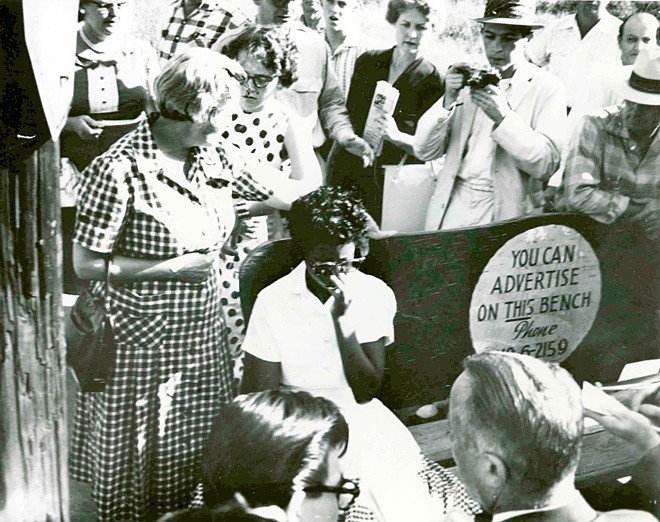
Why am I thinking of Little Rock, Arkansas, in September of 1957?
I knew about the Little Rock Nine, but I didn’t know how bad it was. Because the Supreme Court had ruled on school segregation in 1954, and the message was pretty clear. Still, Little Rock waited until September of ’57, and then decided to admit the nine brightest black kids they could find to Little Rock Central High School.
Nine kids. No problem, right?
Yes, a problem in Little Rock, Arkansas, in 1957. So the governor, who was a moderate, decided to do what anyone would do. Call out the National Guard to…
…prevent the black kids from entering.
Right, if you going to do something like this, you’re going to do it in a group, so no wonder that the nine black kids, with their parents and ministers, presented themselves en masse, or as much of a masse as they were. As you can see in the clip below, there was a hell of a lot more masse standing around jeering at the Nine.
Which was actually only Eight, since one girl, Elizabeth Eckford, hadn’t met with the others. So when she showed up, it was she against a whole crowd of white folk. Unbelievably, she attempted to get into the school, but was turned away as well. Then, an angel appeared. Enter Wikipedia:
On their first day of school, the Nine were to arrive together however this instruction never reached fifteen-year-old Elizabeth Eckford who arrived separately and found herself facing an angry mob threatening to lynch her. Grace Lorch arrived, having just dropped off her daughter at a nearby junior high, rescued Eckford and escorted her home. Lorch's rescue of Eckford made the Lorches a target. Dynamite was placed in their garage, they were harassed in the press, Alice faced bullying at school and Grace was subpoenaed by the Senate Subcommittee on Internal Security.
So the nation sat and watched as the National Guard busily flouted a Supreme Court order. And was anybody gonna do anything about that?
The NAACP got into the act, went to court, and Eisenhower? Our president at the time? He had a meeting with the governor of Arkansas, in which he thought he had convinced him to admit the black kids. But nope, that wasn’t how the gov saw it. What did he do?
Buckle up, Dear Readers, because it gets no better.
He removed the Guard, leaving the city police in charge of assuring the safety of those nine kids, as they finally made it into the school, through the side door.
You can see it in the clip below: to whatever degree the cops were inclined to protect the order and peace, when the crowd began pushing the wooden barricades and scrambling towards the school? Well, those were the friends, family and neighbors of the police. So by this time, the kids were huddling in the basement, when somebody came up with a great idea—allow the crowd to lynch one kid as a decoy, and the rest could escape!
Fortunately, the Assistant Police Chief spoke the obvious—how are you gonna choose which one? Draw straws? So the cop got the kids into two cars, and told the drivers: once you start driving, do not stop.
Finally, Eisenhower acted, calling in the 101st Airborne Division of the Army, and putting the local National Guard under federal control. So the situation was stabilized—except for minor little incidents like a bunch of white girls trapping one of the black girls in the lavatory, and dropping burning pieces of paper on her in an attempt to burn her up. Girls? It works best if you douse with gasoline first….
So they got through that year, and then what did the governor decide to do? Well, how logical could it be—close all the schools! Of course, there had to be a referendum on that but no problem, because that was easy. The referendum passed, and the schools were closed for a year.
Wow—the kids must have loved it, or at lest the white ones….
Well, I had really feared that I’d have to weigh in on the 50,000 kids that have walked through much of Central America and the entire length of Mexico, only to find hate at the other end. I thought I’d have to get down, get dirty, mix it up a bit and get it settled. All in a day’s work for this blogger! And what have I done? Well, I’m heading into page four and 1400 words. But the good news? Jon Stewart has done it far better than I could. And just in case there’s anybody out there who still needs to be convinced, who still can shout “NOT OUR PROBLEM!” well, let me repeat Jon Stewart’s question, this time without the bleep:
What the fuck is wrong with you?


Saturday, May 3, 2014

My Breakfast with Tony

It was a good thing, I decided, that the Internet decided to take the day off and go to the beach, because it allowed me to skip reading about today’s corruption and read about corruption in the past.
“It’s going to be one LONG book,” I had told my friend Tony—more formally known as Antonio Quiñones Calderón,—when he first told me about his project, a book entitled “Corrupción e impunidad en Puerto Rico”—and yes, it means exactly what you think. In fact, it came in at fewer than 600 pages, which surprised me, until I realized that the bulk of the book—very logically—concerns the 20th century and the first decade of the 21st. In fact, the book is divided by decades, and 1900 starts on page 61.
Why decades, I wondered, instead of administrations? And obviously, others must have posed the question to Tony as well. His answer, sensibly, is that corruption isn’t limited to one party or another.
This, of course, on an island where partisan politics reigns, tends to be sniffed at. “Those damned populares are just better at it,” once cried Mr. Fernández, when I reminded him of the flagrant corruption in the Rosselló government. Nor was it any use to suggest that incompetence was hardly an excuse for dishonesty.
So having had breakfast with Tony, and having gotten a copy of the book—thanks, Tony!—I went to the café, where the Internet had decided to go off somewhere, and without leaving a note. So I sat down, and began reading—and fascinating reading it is.
One of the most troubling things about living in a society riddled with corruption is that, over the long run, you go numb to it all. Was that the theme of William Bennett’s book, The Death of Outrage? If so, it’s true. So it was instructive to read, in the first chapter, three months of reports of corruption, starting with one of my favorites, albeit forgotten. (See?) And that was the arrest, on 7 October 2010, of 61 state police, 16 municipal police—133 law and order guys in all—offering their services to protect drug dealers at their work. In fact, there were 125 audio recordings and videotapes of some 89 officers providing protection with their weapons in the sale of cocaine in the amounts of five kilograms or more. No wonder that Eric Holder came out and said that it was the biggest police corruption case in FBI history….
‘Aha’ I thought, ‘so that’s the answer to the question.’ And the question was?
“Where is your nearest punto de drogas (drug hot spot),” I would ask the students, and it was a rare student indeed who couldn’t tell me—though they all denied vehemently having even thought about using drugs, not even marijuana in college.
“So why do you guys know, and not the cops?”
¿Cómo se dice “shrugs” en español?
In short, the cops not only knew but were providing protection to the drug dealers.
As Tony points out, corruption isn’t unique to Puerto Rico. Still, it’s a bit off-putting to read, towards the end of the first chapter, that Puerto Rico, with its 130 convictions of corruption in 2011, had the highest rate of corruption of any federal district. California, he writes, with its four districts and ten times the population of Puerto Rico, had “just” 52 convictions.
Nor is it a recent problem—the first recorded case was in 1720, though why do I think that there had to be others preceding it? Historically, one of the most famous cases—though by no means the worst—was the practice in the 1940’s and 50’s, a week or two before the elections, of high leaders in the political parties walking through the mountain towns, distributing shoes. Well, jaundiced tongues—a medical impossibility, but you know what I mean—said it was a clear attempt at vote buying, but any reasonable person could see: how could any soul walk barefoot over the rocky roads to the polls to cast their vote? The practice ensured a fair election!
Then there was the practice of routinely walking up and down the aisles of the government offices and stopping by each desk, in order to collect money for the political party in power. After all, the reasoning went, you had your job due to the party, so shouldn’t you give back?
Presumably, none of these practices are occurring now—although I did hear reports in the 90’s that the Office of the First Lady was doing essentially the same thing—but it may be that the corruption has both gotten far more underground and pernicious. In the year 2009, as Tony wrote, the cost to the taxpayer in Puerto Rico was 860 million dollars. The average in the 90’s? 417 million dollars.
It goes on and on. Today’s print edition of El Nuevo Día, for example, has an article on Crece 21, a program paid for by federal monies from No Child Left Behind that was supposed to provide training and certification in specialized areas like math, science, and English to 5,000 teachers around the island. The Feds paid the Department of Education; the Department in turn contracted the University of Puerto Rico to provide the instruction and administer the tests. According to the university, they put in 44 million dollars; the total amount of the funding was 49 million dollars.
Of course people are fighting about what happened. The Department of Education points out that only 350 teachers ever got recertified, and that they won’t pay another nickel. The university says that they only got paid 26 million dollars, and that the program didn’t require that 5,000 teachers passed the test, but only that 5,000 teachers “updated their knowledge and were specialists,” according to Yanaira Vázquez Cruz, the director of the program. Oh, and the teachers complained that they didn’t get materials, among which were computers that they could keep if they were certified.
“Some of those teachers really made me angry,” said Lady, the owner of the café, when I told her about all this. “You know, I was in the public schools when I was doing Poetry Out Loud, so I saw how they worked. And one teacher—of 11th grade, no less—was spelling “that” as “taht.” Not once, but in every sentence. So I corrected him, and he got angry and started shouting that it was HIS classroom, and how dare I correct him in front of the students….”
I’ve only read a few chapters of Tony’s book, but I wonder if he ever comes to the conclusion that I—sadly—have come to. And that is?
The intention on Crece 21 was never to certify 5000 teachers, or expand the knowledge of 5,000 teachers, or even to do anything at all to improve the education of the kids on the island. What was the point of the program?
It was about taking the money that was there. There were funds available, there had to be a program, one was created, Washington sent the money down. What happened to it after that?
We’ll never know. The documents don’t exist; the documents are incomplete; the documents contradict each other. Most likely it will be a combination of all three. Oh, and the feds will have to send someone down, someone who speaks Spanish, someone who can wade through the mess of mildewed documents, flared tempers, pointed fingers.
A friend once told me that the worst thing about totalitarian governments was not the repression, not the suppression of free speech and essential liberties, not the sound of footsteps on the pavement outside and the dreaded knock on the door in the middle of the night. No, on a day-to-day level, the worst thing was inefficiency.
I hate corruption on moral grounds. But on an island where an English teacher cannot spell the word “that,” I hate corruption on other grounds as well.
We don’t have this money to waste….

Friday, January 31, 2014

The Priest Who Couldn't Be Bought (Part 1)

It’s the stuff of movies.

He was a man of God, a man with a mission, a man who stood firm against the narco-traffickers who were using children—“children!” he exploded, when he first heard of it—to act as runners in the drug trade. As they grew up, they rose in the organizations, gradually working the puntos de drogas, picking up the drugs from the cigarette boats (so-called because they were low, to escape detection by radar, and resembled a box of cigarettes) as they skimmed over the emerald waters of the placid Caribbean.

He was in another world, a world far away from his native Poland, from his town 200 miles south of Warsaw, a town where his family had lived for generations, and where each day, his mother would rise at 5:30, dress hurriedly to the sound of church bells, and start her day by attending mass at the Holy Trinity Catholic Church.

The church—how much had he loved the church! The scent of incense, the swishing of the priest’s cassock as he waddled to the altar, the altar boys lighting candles, their eyes raised in adoration at Father Jozef. The mothers at mass were surging with pride. One day, vowed little Wojciech, it would be he standing at the altar, helping the priest, smelling the incense, feeling the heat of his mother's love as she watched her beloved boy.

There was never any question of it. Did anyone doubt that this quiet, solitude-loving boy had a vocation? He was as much a fixture in the church as the altar itself. And what an exciting time to be Polish, as the whole world fell in love with the first Polish pope, who had stood up to the Communists and won, who travelled the world so that the multitudes could roar the approval and love! He entered the seminary as you and I enter our homes.

There were hints of it, of course. A priest would be moved suddenly, sent off to a distant parish. Wojciech himself had had various priests keep their hands just a bit too long on his shoulder; gaze into his azure eyes just a bit too long. Had he done something wrong?

Later, he would know more about the filth, the corruption that had crept into his beloved church. There were the priests who organized the camping trips—just the priest himself and five or six boys. Never any parents to sleep in the tents or the cabins; why, wondered Wojciech? And a boy who had left sunny and mischievous, afraid of nothing and no one, would come back sullen and inward.

The day of his ordination, the happiest day of his life! All his family there, his mother beaming, telling Father Jozef, now so old but no less fat, how happy she was to give her son to the church.

“My child, you have made the greatest sacrifice to the Church. Wojciech may travel far, to distant lands, spending years toiling in the meanest, poorest hamlets, bringing the light of our holy church, shining the beacon of our Lord Jesus Christ. God will reward you, my dear….”

But in his first years, he had stayed in his beloved Poland, endured its winters, rejoiced in its lissome spring, and most, savored its rich food, and swum in the comfort of his native tongue. His family he saw frequently, his parishioners claimed him as their own.

“You do speak Spanish, don’t you?” asked the Monsignor.

“Hardly,” replied Wojciech.

“But you studied it in the seminary?”

The teachings of Paul, Sir Thomas Aquinas? Those he had devoured, his pursuit of Spanish was leisurely.

‘It was like being shoved into a sauna,’ he thought, as he remembered standing at the top of the runway steps, paralyzed by the heat and humidity, which the Dominicans behind him so much wanted to embrace, to frolic in. He looked out the window at a road well paved but carless. Indeed, the activity on the road was principally on its side, as streams of bikes and scooters—with several people clutching precariously atop them—whizzed by. The road was flat, but moving relentlessly to the Cordillera Central, the backbone of the island of Hispaniola. Shacks appeared now and then on the side of the road—men sat sitting on broken wooden chairs, seemingly with nothing to do. ‘Why aren’t they working the fields,’ thought Wojciech. In Poland, no man would have dared to be seen out of his house, sitting idle.

The car began to rise, to climb the foothills, to slow slightly as they passed villages—wooden shacks with rotting zinc roofs, the doors open and the barefoot, dirty children gazing out at the passing car. They passed dozens of villages; Wojciech’s heart thudded when he thought, ‘this car will stop, and I’ll get out in the infernal heat, and look around at the poverty and squalor, and that’ll be my town, until somebody tells me it’s not. My God, can I do this?’

He thought back to his homeland; the poor there did their best to hide it—keeping their clothes tidy no matter how old or how mended. They would have scorned to have junk in their yards, to be braying so blatantly their indifference to their own poverty. But these people! Their poverty was a sheet on the wash line, hung for all to see!

The car slowed, slowed more than it did merely to pass through the town. Wojciech’s stomach churned.

The church was the only thing that Wojciech could appreciate; it was erected with twin towers in the Italian style sometime in the 19th century. The toadstools of huts had seemingly sprung up decades ago, and had refused to be eradicated.

His dislike of Padre Julio, standing to greet him in the rectory, was visceral—less a feeling than a blow. Sweat and grease and the stench of garlic oozed out of him, his eyes shifted away from Wojciech and drifted off to something more interesting—or was it an insult? A dismissal? Padre Julio spoke a greeting, not bothering to clean up his broad, coarse Dominican Spanish.

“Cerveza?” asked Wojciech, pronouncing his zeta with the Castilian th. Padre Julio snorted, and ambled off, not even bothering to show him his room. Though, it was obvious; opening one door, Wojciech saw a room strewn with clothes on the floor, an overflowing ashtray, beer cans resting where they had been tossed. The next room was hardly clean, but at least visibly unoccupied. Wojciech put his suitcase in the exact center of the bed, and began placing his shirts on hangers. They’d have to be ironed, of course, but they still had to be hung—one the right, as he had done since childhood. The pants, mostly, were permanent press, and might need just a firm hand to flatten out the wrinkles. Fortunately, the dresser was in good condition, and could receive his t-shirts in the top drawer, underwear below, socks underneath that….

Wojciech washed his face and stood facing the door. A clash of music from the several open bars slashed through the door. ‘Do I have to?’ a voice pleaded within him.

But he knew: if he didn’t face it now, he never would.

Note: I have written so much about the two Polish priests, the nuncio Jozef Wesolowski and Wojciech Gil accused of sexual abuse of minors in the Dominican Republic, that even I am tired of it. The Dominican government wants them extradited: Wesolowski is in the Vatican, which has no extradition policy; even if it did, Wesolowski is protected by diplomatic immunity. As for Gil, Polish authorities have refused to turn him over. Or as the Dominican press reports:

Más temprano las autoridades polacas informaron que no hay posibilidad de trasladar al sacerdote a República Dominicana para ser juzgado.

(“Earlier, Polish authorities announced there is no possibility to transfer the priest to the Dominican Republic to be processed.)

Gil has claimed that the power drug lords have framed him, as he fought courageously in defense of the children who were being lured into a life of crime and violence. He pointed out that the computer on which the 500 photos of underage children engaged in sexual acts were put there by someone else—it was a shared computer.

And now, according to one account I read and now cannot find, after the denunciations of last May the village has gone silent. Why? Is everybody just tired of it? Or is someone putting screws? The drug lords? The Church?

I thought about it all over the joe of the morning, and thought, ‘well, what if?’ Jack, my newspaperman father, had been glowering—one of his talents—down at me for a while. Dig for the facts, tell ‘em straight, give both sides of the story, and then go hunt for the next story. Had I been doing that?

So here’s the other side….          

Tuesday, January 21, 2014

The Vatican Gets Tough

Wow—strong stuff.
True, the Vatican announced recently that Jozef Wesolowski, the former Papal Nuncio to the Dominican Republic and Puerto Rico who is the highest-ranking official in the Catholic Church to be charged with child sexual abuse, won’t be extradited either to Poland or the Dominican Republic. Why? Because he’s in the diplomatic corps of the Vatican, which doesn’t permit extradition.
This was announced a few days ago and discussed in Geneva, Switzerland, in what The Telegraph called “an unprecedented grilling” by the United Nations. Instead, he will face trial in the Vatican. And, assuming he’s found guilty, he’ll serve time there.
Very convenient, because... Dominican jails? Well, Puerto Rico got an earful about them when a journalist ventured off to the Dominican Republic and got herself into some trouble over a little cocaine deal. So the island stood on its ear for months and watched as she got tried and convicted.
I’ve tried to google “Dominican Republic jails” but guess what? The Internet is off somewhere in a meeting—presumably on how to be capricious, willful, and completely unreliable, as well as maddening—so this account of Laura Hernández is completely from memory.
But if memory serves, the Dominicans start with the presumption of guilty until proven innocent—a nice little Caribbean twist on things. And unlike the United States, which according to today’s edition of The New York Times is seeing a surge in request for Kosher meals (which are better and four times more expensive than regular prison fare), Dominican jails tend to offer a more basic experience. Which is to say that the family has to bring in the food, personal hygiene items, and pretty much everything else. And as I remember it, the floor was dirt. Nor was there a bed….
And so for a period of several years, the island was treated to pictures of Hernández, who was reliably sobbing, and the inhumane, awful treatment she was receiving. And then, one day—presumably after some pressure from the United States—Hernández was freed.
Well, Wesolowski had a habit of drinking beer—very Caribbean—and walking the MalecónCaribbean, yes, but, in this case, an area associated with kids who provide services not encouraged by the Catholic Church. Officially, that is.
So the top guy in the church went off and told the new pope—whom we’re all in love with—that the Dominican press was about to out Wesolowski and another Polish priest. And what happened? Did the Vatican follow its own rules—which as I remember require the offending clergy to be turned over to local authorities and jurisdiction? Nope—the Polish priest returned to Poland, and Wesolowski was recalled to the Vatican. And also, if memory serves, there were rumors swirling about false travel documents.
Well, whatever the Vatican is going to do, it has acted swiftly and decisively in at least one action. And that would be? They photoshopped him out of an official picture. Here’s the Telegraph on the subject:
In the original picture, he appears smiling in the second row, wearing a dog collar, black vestments and a heavy crucifix.
But in the re-touched photograph, his head has been replaced by that of an emeritus bishop, Francisco José Arnáiz.
The Huffington Post, writing of Wesolowski, said this:
His case has raised questions about whether the Vatican, by removing him from Dominican jurisdiction, was protecting him and placing its own investigations ahead of that of authorities in the Caribbean nation.
Raised questions?
Not for me!